


The Wodaabe also known as Bororo are nomadic cattle-herders and traders that forms a subset of the larger Fulani (Fulbe) ethnolinguistic group in the Sahel, with migrations stretching from southern Niger, through northern Nigeria, northeastern Cameroon, and the western region of the Central African Republic. Nowadays Wodaabe or Mbororo are also found in countries in East Africa, including Kenya, Uganda and Ethiopia.

Wodaabe man from Mali at Gerewol Festival beauty Contest for men
The Wodaabe/Mbororo–Fulani, who are the largest nomadic group in the world, play a crucial economic role as seen in the following remark by Weeks (1978: 133), “Their herds of cattle and sheep are the major source of meat for hundreds of villagers, towns and cities from Wadai, beyond the shore of lake Chad to the Atlantic coast of Senegal.”

They are known for their beauty (both men and women), elaborate attire and rich cultural ceremonies. Obsessively vain, exotic, strange, and foreign–these are words frequently used by Europeans and Americans
to describe the Wodaabe/Mbororo-Fulani. In her 2001 book, Nomads Who Cultivate Beauty, Mette Bovin confronts these stereotypes. She notes that although many may believe that the tall thin Wodaabe men–who paint their faces yellow, widen their eyes, and quiver their black painted lips during annual dance performances–resemble “homosexuals or transvestites,” Wodaabe men are, in fact, dressing “for the sake of young girls” (p. 41). The Wodaabe, especially men, “use enormous amounts of time, energy and money to become pretty, handsome, beautiful, ’exotic,’ attractive, elegant, refined, and symmetrical in poor surroundings” (p. 9).

Gerewol festival of Wodaabe people
The WoDaaBe/Mbororo-Fulani have a wonderful Gerewol festival, an annual courtship ritual competition. Young men dressed in elaborate ornamentation and made up in traditional face painting gather in lines to dance and sing, vying for the attentions of marriageable young women. In outlining the the yaake dance, Bovin explained that male dancers strive to imitate the grace and elegance associated with the long-legged white cattle egret, attempting to harness the power of the bird. Bovin writes about Wodaabe women that they appear to play a peripheral role.

Yaake dance of Wodaabe peopler
For example, Bovin writes that during yaake performances, women “stand in a crowd at a distance, they look shy, but they are in fact active and important spectators. Women judge and choose among the men!” Bovin continues to state that women “choose not the ”Miss Wodaabe“ but the ”Mr. Wodaabe“ of the year!” (p. 47). In fact, the “names of male beauty contest winners are remembered for several generations” (p. 68).

Wodaabe people from Central African Republic
WoDaaBe/Mbororo-Fulani are used in the world of images through the commercialization of products. Anita Roddick, the founder of the multinational cosmetic company the Body Shop, has associated images of the WoDaaBe/Mbororo-Fulani with her beauty products (see Zinn 1991). Probably, the Body Shop’s association with the WoDaaBe is intended to underline the company’s association with nature, which the company’s identity is based on. In a research trip for the television series Millennium, Roddick spent two weeks with the WoDaaBe/Mbororo-Fulani (Roddick 1991:182). She recounts that: “I have also learned the pure joy that is to be obtained frommixing with simple people whose lives are untainted by what we have laughably described as ‘progress’” (Roddick 1991:181).

WoDaaBe/Mbororo-Fulani have a high degree of mobility, moving on average every three days, making use of the scattered distributed resources and fitting their mode of production into the pulsating environment of their arid habitat (see Johnson 1993: 27; Glantz 1987: 51). Material culture is well adapted to this mobility; belongings few and thus easily transported to a new location. During the rainy season, the different patrilocal lineage groups stay close together making social activities more intense. During the dry season, however, camps are spread out over a large area, making social interaction minimal due to the long distance between the different camps. A council of men (suura) discusses and decides movements within the lineage group, even though each head of the household, always a male, is free to move when and where he wants. This high migratory nature of Wodaabe/Mbororo-Fulani and its attendant destruction of lands and property of the areas (countries) they pass through is one of the major inter-ethnic conflicts in Sub-Saharan Africa.

Wodaabe people from Niger
In the Fula language, woɗa means "taboo", and Woɗaaɓe means "people of the taboo". "Wodaabe" is an Anglicisation of Woɗaaɓe. This is sometimes translated as "those who respect taboos", a reference to the Wodaabe isolation from broader Fulbe culture, and their contention that they retain "older" traditions than their Fulbe neighbors. In contrast, other Fulbe as well as other ethnic groups sometimes refer to the Wodaabe as "Bororo" (singular: Mbororo), a sometimes pejorative name, translated into English as "Cattle Fulani", and meaning "those who dwell in cattle camps". By the 17th century, the Fula people across West Africa were among the first ethnic groups to embrace Islam, were often leaders of those forces which spread Islam, and have been traditionally proud of the urban, literate, and pious life with which this has been related. Both Wodaabe/Mbororo and other Fulbe see in the Wodaabe the echoes of an earlier pastoralist way of life, of which the Wodaabe are proud and of which urban Fulbe are sometimes critical

The Wodaabe/Mbororo-Fulani can be divided into three major ethnic groups identified by the colour of their cattle, style of decoration of their bowls, and migratory movements. These are the ‘Aku-en’, Bodaabe and the ‘Jafun-en’.

WoDaaBe/mboror-Fulani pastoral nomads in Niger live in mobile cattle-camps, their ethnic identity and economic subsistence based on cattle herding. WoDaaBe often refer to themselves as the birds of the bush (solli ladde) or as the people of the bush (taguu ladde), thus associating their ethnic identity strongly with their natural environment, recognizing the economic and symbolic association of humans and environment. In other contexts, however, WoDaaBe characterize themselves as separate from their physical environment, posing the home (wuro) and bush (ladde) as structural oppositions. Cows are described as domesticated and “wild,” indicating their role in mediating between nature and people - between a social and non-socialized space.
In Cameroon Wodaabe/Mbororo’en (singular: Mbororo) are found all over the national territory under four Lamidats (the paramount traditional institution) under whom are found community leaders called Ardos. The four Lamidats are found in Fuigil in the North Province, Lompta in the Adamaoua Province, Sabga in the North West Province and Didango in the West Province.
The Mbororo in Central African Republic can also be found in the prefectures of Ouaka in region 4 in the centre-east; M’bomou in region 6 in the south; Nana-Mambéré in region 3 in the north-west and Ombella-Mpoko in region 1 in the south-west. The 2003 census gave an Mbororo population of 39,299, or 1% of the population. There is a higher proportion of Mbororo in rural areas, where they account for 1.4% of the population, than in urban areas where they represent only 0.2%.

Wodaabe/Mbororo-Fulani Migratory nature and area of attachment
WoDaaBe/Mbororo-Fulani have several kinds of migrations, which can be divided into short movements aiming at finding nourishment for animals, and a transhumance movement between rainy season and dry season pasture. In spite of a high degree of mobility, WoDaaBe/Mbororo-Fulani tend to use the same general areas year after year.

WoDaaBe/Mbororo-Fulani have an extensive vocabulary referring to migration movements, and different groups have to some extent different usage (Loftsdóttir 2000). The different movements can be classified according to the length of movement they refer to and the season which migration takes place, in addition to referring to various special distances such as the length from well, the closeness to the previous occupation spot (see also Loftsdóttir 1997).

Mbororo girl
In addition, WoDaaBe identify a historical migration called perol. The term refers to a migration out of the ordinary, often a temporarily exploitation of new and foreign spaces, thus not only taking the group from its area of attachment but to an alien territory. Perol is thus an adaptive strategy used in difficult ecological and political situations. The movement can be permanent, even though probably in most cases people wish to return to their gari.

WoDaaBe/Mbororo-Fulani refer to the dry season pasture or the area around the most frequently used wells as an “area of attachment” by the concepts gari or ngenndi. The concept gari, refers to an area that has either a town or a water-hole place, because “that is the place where people sit down.” Thus, the idea and utilization of gari involves coexistence of human beings with an environment. Even though the rainy season pasture is often in the same area year after year, the rainy season pasture is normally not referred to as gari.
Pastoral societies generally subsist on millet consumption, which provides higher caloric values. In order for a complete dependency on milk to be possible the animal human ratio must be extremely high (Gefu 1992: 20). The association of an “area of attachment” and settlement underlines the importance of millet for pastoral societies, and thus the affiliation with agricultural societies, which constitute a part of WoDaaBe social structure and history (See Dupire 1972: 12). The bush in the context of their area of attachment is thus a highly socialized space, involving the presence and relationship of people of different ethnicities having important trading relationships. In this context, the town10 is also clearly not an opposition to the bush (ladde) in which they live, but a part of it.

It should be underlined that gari does not refer to a populated area. Images awakened when discussing ladde (and thus gari) destruction shows this clearly, phrasing it as ladde wati, translated literally as the “bush has died.” Ladde wati is described as an area that wild animals have left, where trees have been cut down, fields are extensive and population high. As explained to me: “That is no longer a bush.”
WoDaaBe have another concept, ladde hurram, which refers to a more “wild” bush. This concept is used regarding space lacking human settlement, i.e., people, waterholes, and towns are absent. When people explained this concept to me, they emphasized that not only does it refer to a space without human beings but is occupied by thieves and evil spirits ginni (sing. ginnol), making it inherently dangerous. The problem of thieves and spirits also exists in ladde but becomes more acute in ladde hurram, because the presence of people and the intimate knowledge people have of ladde makes the ladde more secure. When these concepts, si'ire (town), ladde (bush), ladde hurram (“wild” bush) are placed in connection with each other, it can be suggested that they existing on a scale moving from a dense human population to the lack of it.

Mbororo man from Mboki, Cameroon
Wodaabe-Mbororo-Fulani Settlement
The WoDaaBe/Mbororo-Fulani home wuro (pl. gure) is composed by several smaller units called cuudi (sing. suudu).The concept wuro goes beyond referring simply to a "house," but describes a sociographic unit, headed by a man, which usually is tied together by kinship (Riesman 1977: 31). The suudu is composed by a bed (leso) and table (saga) which are marked from their surroundings by a half circle of branches placed on the earth. Each suudu belongs to one wife of the household and it is almost exclusively a woman's space. She spends most of her time in or around it, all her belongings are usually there, and she invites her friends and family into this space (see also Sa'ad 1991: 212; Bovin 2001: 62-64). The wuro, however, is seen as belonging to the husband; he takes decisions where to make it, how often and with whom. The mobile characteristics of the wuro means that it is not a structure rooted in a place but characterized by its objects, in addition to referring to highly regulated spaces.

Mbororo woman from south Sudan
These various organization aspects of the wuro, such as who makes it, where, with whom and when, as well as its spatial organizations, are understood not only in gendered terms but also to some extent in ethnic terms. Even though the term wuro is used over the homes of other ethnicities as well, its main organizational characteristics are linked with WoDaaBe/Mbororo-Fulani social and political organizations. The wuro (and the suudu) constitute points of reference in relation to the WoDaaBe/Mbororo-Fulani lineage systems and are often conceptualized as the smallest units of the lineage structure (see also Bonfiglioli 1988). The mobility, crucial to the form and existence of the wuro, is also seen, as previously discussed, as an integrated part of WoDaaBe/Mbororo-Fulani ethnicity.
In a similar fashion to the area of attachment, the wuro is conceptualized as a space of human coexistence, of solidarity and safety. The further away one is from the home or from a human settlement in general, the greater the danger may be waiting in the bush. These dangers are partly derived from the physical characteristics of the bush, where people can get lost and die of thirst but also dangers of being attacked by thieves, ginnol, or in the past, wild animals. WoDaaBe/Mbororo-Fulani survival strategy depends on co-operation and closeness to other human beings, rather than the exclusion of them. The WoDaaBe/Mbororo-Fulani cattle-loans demonstrate that WoDaaBe/Mbororo-Fulani relationships are strategies for a safer survival. Cattle-loans (habana’i) are a social institution among the WoDaaBe/Mbororo-Fulani which redistributes wealth. Individuals can invest in social relationships by lending out their cattle. These strategies of increasing safety in an unpredictable environment are informed and understood with reference to WoDaaBe/Mbororo-Fulani ethnicity, because, as it is explained, "someone who does not want to engage in cattle loans is not a WoDaaBe."
Individuals are also safe as long as they stay within the human settlement, i.e. the home, and the home is safer when not too far from other camps. The camp is, as this man stated, not only a place of safety for human beings but also for the domesticated animals. The cows graze at night in a group (sogal), but smaller animals depend on the safety of the house to avoid being eaten by wild animals. In the dry season when the camps are far from each other, the camps are more vulnerable. The rainy season is the time of prosperity and safety which is to some extent due to the short distance of the houses from each other. In the dry season, the bush is considered to be dangerous (kalledum) because the other camps are far away and crimes occur frequently, partly because people are more vulnerable due to their isolation, but also because of an increased shortage of food. People feared, for example, more for my safety during the dry season in the bush than during the rainy season.
WoDaaBe conceptualize their wuro as a safe area that is, on some level, a part of the bush but also as distinguished by the bush around it. As stated by Riesman, “the bush is at once near and far” (Riesman 1977: 251).

Language
WoDaaBe/Mbororo-Fulani speak Fula language which belongs to the Senegambian branch of the Niger–Congo language family. It is spoken as a first language by the Fulɓe (Fula or Fulani people) and related groups (such as the Tukulor in the Senegal River Valley) from Senegambia and Guinea to Cameroon and Sudan. It is also spoken as a second language by people in the region.

History
Instead of focusing on the rich history of the Fulani, Westerners were preoccupied with myths of their pristine origin outside Africa. One theory was that the Fulani were a mixture of Jews and Arabs with a Sudanese tribe of Cushitic origin, who came to Africa in the early days of Islam (see discussion in Meek 1925:95). Lieutenant Boyd Alexander argued that the Fulani are “interesting people of Eastern origin, who are believed to have settled in Egypt from farther East, and to have been driven out of their adopted country during the Theban Dynasty, 2,500 years ago” (Alexander 1908:190). One well known theory regarding the origin of the Fulani was M. Delfosse’s thesis that they were a group of Armaic-speaking Judaeo-Syrians who entered “Negro” Africa from Cyrenaica about 200 A.D. (see discussion in Greenberg 1949:190) and then became the white rulers of Ghana from the fourth to the eighth or ninth century (Meek 1925:95).

Wodaabe nomad girls returning from the well with water hanging in goat skin bags under their donkeys' bellies
To maintain this conception of the caucasoid origin of the Fulani, it was often argued that the language of the Fulani was Hamitic, an idea which was met with wide acceptance (Greenberg 1949:190). Delfosse states that Fulanis were the" fruits of the marriage between Oukba and Bajjo Mango were four children, Deita, Woya, Roroba and Nasi. He claims that, they are the actual ancestors of the Fulani who started speaking Fulfude. Arnott (1970:8), agreeing with the above view, further note that after some time the ancestors separated and one of the group moved to Futa–Toro (Senegal Basin). This was further confirmed by Murdock (1959:415), who linked the Fulani to the Tukular tribe who still inhabit the middle region of Senegal. This view is supported by Sa’ad (1977) in the following statement. “The earliest centre of the Fulani in the western Sudan was the region of Senegal Basin but today, they are found as far as Sudan and Ethiopia…”

In another work by St. Croix (1945: 9), he narrates a legend which explains the origin of the nomadic Fulani. The narration indicates that the nomadic Fulani are descendants of a baby who was left in the bush by the mother due to a quarrel between she and her husband. A spirit found the baby and promised him that, he would roam continuously in the bush but would be rewarded with a lot of wealth. The boy was advised to go to a river where in a line of cattle would emerge. He was counseled by the spirit to lead the line of emerging cattle and not to glance behind. The boy failed to obey the instruction and looked behind. He did so and the emerging cattle from of the river stopped when the most beautiful beast was emerging.

The WoDaaBe have been referred to in more recent publications as primitive fossils having survived through the twentieth century. One text describes them as “unique people, believed to have been among the first inhabitants of Africa, the descendants of the mysterious people of an ancient area who sculptured fantastic drawings into the rocks” (Chesi 1977:65). Another relatively recent text states that nomadic Fulani have a striking similarity to rock paintings in the Tassili caves in Algeria dating from 4000–2000 B.C. (Beckwith
and van Offelen 1983:30).The text claims to be able to separate “negroid figures” in these ancient paintings (Beckwith and van Offelen 1983:30), thus again separating the nomadic Fulani from“blackness.”
Professor John Coleman DeGraft-Johnson, the celebrated African historian from Ghana averred that Fulanis were already in Futa and Senegal when the Jews that fled from Cyrenaica as result of Romans persecution came to meet them. He asserted that "There is perhaps no group of people in Western Sudan with more Jewish blood in them than the pastoral Fulani in Futa. who, by mixing with the people of the shores of Lake Chad, passed on their Jewish blood to the areas around Kanem and Bornu several centuries later."

Palmer (1967) supports the aforementioned perspective and further recounts that the hybrid and Arabs, who eventually penetrated into the Maghrib in North Africa about 650-750 A.D. mixed with another group of people, the Duradae. According to Palmer, the Duradae are the source of the “Fulani proper”. Meek (1913) on the other hand, links the Fulani with proto-Egyptians and an ancient Libyan tribe. He arrived at this proposition by studying the physique of the Fulani. Furthermore, many writers have traced and attributed the origin of the Fulani to the Arabs as in the case of St. Croix (1945) and Mohammad (1976: 29-33). One of the legends narrated from the latter, explain that the Fulani are descendants of one of the five offspring of Oukba- an Arab, and Bajjo Mango – a Sarakoule. He further narrates that the Fulani were settled in Libya and Egypt and they moved south-westwards to the Bend of Niger and to Futa and Senegal.

The Fulani did not remain or settle permanently along the Senegal River as some of them moved eastward to other parts of Africa, as indicated by Mohammad (1959:226–227). The migration of the nomadic Fulani from Futa–Toro into Ferlo in the south and Kaarto in the east is confirmed by Murdock (1959:417). The Fulani arrived in Masina through Sonika and Bambara in the 14th century, while a vanguard of them infiltrated into Futa Jalon from Senegal. Further migration took them into Hausa land around Sokoto and in Bauchi in Northern Nigeria. Muhammad (1976: 153) explains that the eastward movement was due to the following reasons; the large ocean, which lies to the west; in the north, the Sahara desert is a hindrance and to the south, the thick forest, which breeds the tse-tse fly, made the eastward movement the best option.

Economy
The economy of the Mbororo–Fulani in the early 19th century was exceedingly simple. Cattle had little economic significance and the number a man owned was an index of his wealth and importance. The women were responsible for milking and they carried the milk, with pats of butter floating in it, in large shallow gourds to local markets, where it was exchanged for food grown by cultivators.

Expenditure was on food, salt, payment for ‘gainakos ’(herdsmen) and ‘jangali’ (cattle tax), with occasional purchase of cloth, household goods and saddlery. Mbororo–Fulani sold cattle with the utmost reluctance; the number sold will depend on the expenditures that cannot be met by receipts from the sale of milk and butter by the women. The greater parts of such expenditure were on annual cattle tax paid to the local councils.

Commercial Trade
The handicraft work of theWoDaaBe can be seen as a commercialization of identity related products because these products are marketed and sold as traditional WoDaaBe items. This manufacturing of identity becomes clearer when one realizes that most of those doing handicraft work today are often engaged in the selling of other identity related products than WoDaaBe jewelry, such as traditional WoDaaBe clothing, Tuareg jewelry, and dance performances, which have been popularized in the general media of the West.
WoDaaBe produce several kinds of jewelry,mostly necklaces and bracelets. There are various models available for sale, and while some people are imaginative and creative in finding new ones others simply copy what has already been done.

For many of the objects cowries are used, which were a currency in West Africa for many centuries. Ibn Batuta, for example, who visited the Mandingo Empire ofMelle, in 1352, mentions that at that time cowries were used as currency (Meek 1925:65). The production of jewelry is divided into a number of steps,many items being made at same time, and is thus similar to an assembly line. The most common items of clothing sold are the woman’s skirt (wudere), young woman’s shirt (henare surbadajo) and a cloth used bymenduring dances.This clothing has extensive work in the same embroidery style, a style that is considered distinctly WoDaaBe. Recently, the styles of the embroidered clothing have been expanded somewhat to adapt to what tourists are more likely to buy.These new items include trousers, blouses, and shirts that are shaped like T-shirts.

It is relatively common in Niamey that groups of WoDaaBe are hired to show dances, either by development organizations or foreign cultural institutions.Groups of WoDaaBe have gone abroad to show dances,most frequently to France, Belgium or Holland.These dance exhibitions are usually not well paid, but include the possibility of selling “real”WoDaaBe handicrafts or the Tuareg jewelry. Such dance-trips are simultaneously sales trips selling handicrafts and everyday items such as clothing, swords, jewelry,hats,and dance decoration
items. Silver can bring great profits if taken on such trips.
WoDaaBe can be seen in the “tourist streets” of Niamey and even though not as numerous as Tuareg craft makers, they can be no less aggressive in seeking clients. Several co-operatives have been formed in relation to the handicraft work. The non-governmental organization of WoDaaBe jewelry makers called Cooperative Artisana Bororo (WoDaaBe), established in 1994, was probably the first one. The cooperative built a small house for their craft work with the aid of a Belgian development organization, also getting a donation from a white person they had befriended. Such houses make a great difference,making the craft objects more visible and accessible to tourists and are thus greatly desired by most handicraft makers.

Mbororo women
Construction of Gender
Women andmen pass through several life stages. As a newborn, the woman is called Bikkon dewi kesi, a few months later she is Bikkon dewi jakul; as a child surba’el; as a teenager surbaajo; after her first pregnancy and during the first years of motherhood, boofiiDo; as a married woman yarijo; and as an old
woman nayeejo.Women are defined as surbaajo when they are old enough to be part of the nightly gathering of people, generally as a young, childless, unmarried woman. Surbaajo can be a married woman (if her boyfriend does not make her pregnant), but most married women get pregnant soon and thus the role of the surbaajo is more identified with the unmarried women. A surbaajo is sexually available to men (excluding those with whom she would be seen as having an incest taboo). The surbaajo is well aware of her outer appearance, dresses well if she has the means (often her older sisters or parents give her this clothing or her boyfriend, semaru).

Mbororo woman
A woman becomes boofiiDo when she is pregnant with her first child, but her whole period as a boofiiDo lasts for two or three years. If becoming pregnant by one of her boyfriends, a woman’s actual marriage with her intended husband will be swiftly initiated, and her status is transformed into a bofido.The boofiiDo is symbolically an “invisible”woman, dressed in black and without any decoration. She covers her body with a black cloth and head cover but has no shirt. After her child is born, she walks around with her breasts naked, a cloth wrapped around her hips.When becoming a boofiiDo, a woman leaves the homestead of her husband and returns to stay at her parents’ home. During this period, she will not see her husband nor his family and she has in general no interaction with anyone except the members of her own household. Even during the annual gathering of the lineages, she stays secluded. If visitors arrive at her parents’ homestead, she does not make her presence known. She has no relationship with males, neither her husband nor other men. The boofiiDo has a small bed at the house of her mother, which is situated to the left of the table. She is supposed to help at her parents’ house, and is thus considered to be a valuable contribution to the work force.Awoman is only a boofiiDo once in her lifetime.When awoman’s period as a boofiiDo has ended, she becomes yarijo. She can dress again in a colorfulway and interactwith people. Her life has changed, she is a wife and a mother. A yarijo can obviously not have sexual relations with other men, she cannot be part of the night gatherings and she cannot go out late in the evening without her husband’s permission.
A young man coming of age is, however, simply a kajejo, the term used about young unmarried men,married men, and men with a child or children. His role only changes when he is conceptualized as old, or ndottiijo. Kajejo, therefore is someone who goes out and does what he wants, someone who goes out to find dancing
and find women. Briefly stated, according to these men, kajejo is someone who is enjoying life, and he becomes a dotti’owhen he is old and ugly (i.e.,no longer desired by women).

Mbororo kids, Benin
Gender Relations
WoDaaBe society is characterized by strict division of labor, which can be seen as a reflection of the gender segregation in the society as a whole. Women’s sphere of activities is the home, the suudu, in addition to milking related activities, while men’s preoccupation is with the herd. Men and women do not eat together, and a man would never sit down on a straw mat if women were gathered there, just as a woman would not join a group of men.The everyday relationship between men and women is characterized by reserve and avoidance (see discussion in Stenning 1959).Women are a source of pollution for men, particularly in connection with menstruation. The menstruation blood is considered to deprive traditional medicines of their
powers, and thus women are not able to have many medicines for protection, which are an important part of the man’s life and powers.

Women are generally treated with respect in an everyday setting but women’s stories of themselves and their lives still directly express their fear of men. They fear especially physical violence from their husbands, who are considered to have the right to discipline them. A woman’s parents are not able to interfere directly in the beating of their daughter, but the father or older brothers of the husband do interfere.

Wodaabe mother and her baby
Marriage
The Wodaabe practice polygamy. Marriages are either arranged by parents when the couple are infants (called “koogal”), or they can be because of love and attraction (called “teegal”). The first step, the puDDol, usually takes place when the girl is very young. It is not important how old the boy iswhen this is done,but the girl has to be under 15 years of age.The puDDol involves the killing of a young bull or a sheep, depending on the wealth of the household.The puDDol is not necessarily done at the annual

lineage festival.The next ceremony is simply called kobgal,which involves the killing of a bull (2 or 3 years
old) or a big cow, depending on the situation of the household. Usually the girl is around 11 to 14 years old.
The next ceremony is called bosDi kobgal and involves the killing of a sheep, whose meat is eaten by both
families. Finally, there is a series of several gifts.
Koogal marriage: It takes place through the slaughtering of a bull, uniting two families of the same lineage group. The kobgal marriage is arranged by the parents for two young children, and consists of a series of steps which take many years, but always involve either the boy’s family killing an animal or them giving gifts to the girl’s family.

In Wodaabe culture, men openly contest over a woman, and it's up to her to choose who to be with, and the guys are very civil about it too
Teegal marriage: In performing a teegal marriage ceremony (which is marriage between mutual consenting adults), a sheep is usually slaughtered. In some few instances, a bull is slaughtered; this is usually done if the
man is trying to demonstrate a great affection for the woman, and imitates kobgal marriage.

Suka`en: Suka’en is an institution where the father gives his son his first calf. In some cases, if the man has a great many cows or few sons, the daughters receive a suka’en cow from the father. The calf stays with the father’s herd where it grows and will become what later constitutes the son’s herd. It is important to note that the herd of a household does not only belong to the male head of the household but also includes animals belonging to sons who still make their home (wuro)with their father.These animals will form the basis of what the sons can have later in independent households. Animals thus play a central role in social institutions, constituting a medium where relationships are established in WoDaaBe society.
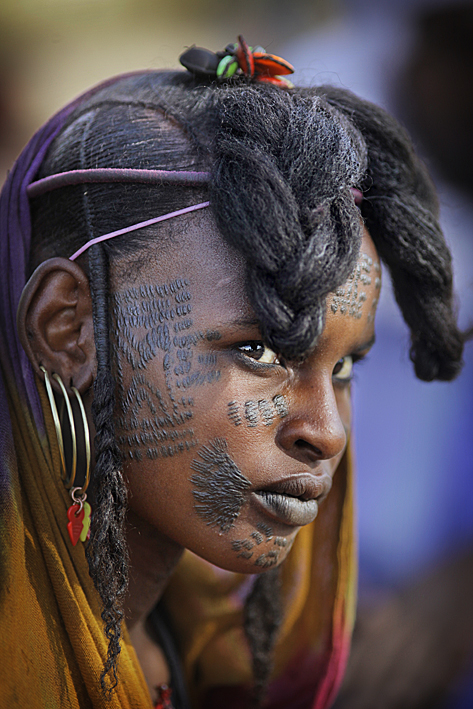
Culture of Wodaabe/Mbororo-Fulani
‘Pulaaku’
The main socio-cultural code for Mbororo–Fulani group is known as pulaaku, a code of behaviour and ethos believed by them to be peculiar to and distinctive of the pastoral Mbororo-Fulani (Kirk-Greene 1986: 42). ‘Pulaaku’ provides both a moral framework and a code of conduct to the pastoral Mbororo- Fulani, and is also maintained by town Fulani. This code of conduct is intimately bound up with nomadic pastoralism and with good animal husbandry. It is also bound up with the fulfilment of duties to elders, wives and the lineage group, and the proper arrangement of marriages. The four dominant strands of ‘pulaaku’ have been identified as: fortitude in adversity and on ability to accept misfortune (munyal); sound common sense and manners (hakkiilo); reserve and modesty in personal relations (semteende); and dignity (neddaaku). For the Mbororo Fulani themselves, ‘pulaaku’ makes them unique and different. It is about dignity and hiding problems.

Pulaaku’ functions as a means of maintaining an ethnic boundary around the Mbororo category, such that it describes an ideology of racial and cultural distinctiveness and superiority that ranks the Mbororo- Fulani above all other ethnic groups (Burnham, 1996:106). The Mbororo Fulani equate their distinctive pastoral way of life with their ethnic origin, to the extent that “there is a strong attachment to the idea of ethnic exclusiveness” (Steening 1959:388) as evidenced by the existence (and use) of disparaging fulfulde terms for sedentary farmers (e.g haabe). There is also a continued tendency to marry within migratory groups, often with close cousins, as a means of preserving ‘pulaaku’. Mbororo culture can therefore be seen as exclusivist in orientation, a factor that has sometimes exacerbated inter-ethnic tension between the Mbororo-Fulani and their farming neighbours. Thus cultural conflict is stereotypically expressed as such:
“The natives in town see the Mbororo Fulani as uneducated, primitive and having a wrong religion. The Mbororo-Fulani in the rural areas looks down on the natives as haabe, mean people who are poor, feel racially superior even to a native who is rich”

As with all cultural codes, pulaaku is not interpreted uniformly amongst in the different ethnic groups, and more broadly remains subject to local interpretation and variations between different Fulani groups across West Africa (Azarya 1999: 6-10).
However, pulaaku provides a unifying factor across the Mbororo-Fulani of Cameroon as between the Jafun’en Bodaabe and Aku’en.

Wodaabe Gerewol festival
The Guérewol (var. Guerewol, Gerewol) is an annual courtship ritual competition among the Wodaabe Fula people of Niger. Young men dressed in elaborate ornamentation and made up in traditional face painting gather in lines to dance and sing, vying for the attentions of marriageable young women. The Guérewol occurs each year as the traditionally nomadic Wodaabe cattle herders gather at the southern edge of the Sahara before dispersing south on their dry season pastures.

The most famous gathering point is In-Gall in northwest Niger, where a large festival, market and series of clan meetings take place for both the Wodaabe and the pastoral Tuareg people. The actual dance event is called the Yaake, while other less famous elements—bartering over dowry, competitions or camel races among suitors—make up the week long Guérewol. The Guérewol is found wherever Wodaabe gather: from Niamey, to other places the Wodaabe travel in their transhumance cycle, as far afield as northern Cameroon and Nigeria

Annual gathering
At the end of the rainy season in September, the Wodaabe travel to In-Gall to gather salt and participate at the Cure Salée festival, a meeting of several nomadic groups. Here the young Wodaabe men, with elaborate make-up, feathers and other adornments, perform dances and songs to impress women.

The male beauty ideal of the Wodaabe stresses tallness, white eyes and teeth; the men will often roll their eyes and show their teeth to emphasize these characteristics. The Wodaabe clans will then join for their week-long Guérewol celebration, a contest where the young men's beauty is judged by young women.

Music and dance
The music and line dancing is typical of Fula traditions which have largely disappeared among the vast diaspora of Fula people, many of whom are educated, Muslim, urbanites. This is characterized by group singing, accompanied by clapping, stomping and bells. The Wodaabe Guérewol festival is one of the more famous examples of this style of repeating, hypnotic, and percussive choral traditions, accompanied by a swaying line dancing, where the men interlink arms and rise and fall on their toes.

The Guérewol competitions involve the ornamented young men dancing the Yaake in a line, facing a young marriageable woman, sometimes repeatedly over a seven-day period, and for hours on end in the desert sun. Suitors come to the encampment of the woman to prove their interest, stamina, and attractiveness. The participants often drink a fermented bark concoction to enable them to dance for long periods, which reputedly has a hallucinogenic effect

Wodaabe women shielding from the sun
Religion
Although one of the first African tribes to convert to Islam, they preserve many of their Mbororo customs. They follow the Muslim rituals of prayer, fasting and pilgrimages, but because of their fear of the spirit world, they wear fetishes and charms, and practice rituals for protection.

Despite this, they have demonstrated an openness to the Gospel, particularly when they see it worked out in deeds of love and mercy.

Wodaabe people
Tourism
The Guérewol ritual has become a foreign tourist attraction since western films, and magazines such as National Geographic, have prominently featured images of the stylized performance

Socio-economic and cultural symbolic role of Cattle
Animals in WoDaaBe/Mbororo-Fulani society have an interconnected symbolic, social and economic meaning. This applied especially to cattle whose multiple roles in WoDaaBe/Mbororo-Fulani society cannot be reduced to a single meaning or purpose. Livestock can be seen as a medium in transforming the shrubs and annual grasses into products that can be used by humans (Johnson 1993: 26). Cows provide people with milk and meat to sell at the market for millet. Not only do cattle carry an reproduction of the social system.

Wodaabe woman from Niger
All major life transitions, such as birth, marriage and death take place with the assistance of cattle. In addition to their role in life transitions, cattle form the basis for the important gift distribution system, habana’i, which both establishes social relationship within and outside the lineage group, leading to the reduction of risk within the pastoral economy. Goats and sheep are a relatively recent addition to WoDaaBe/Mbororo-Fulani economy, serving as a mobile reserve to sell at the market, in addition to sheep serving ceremonial purposes as in other Islamic communities. Donkeys have largely replaced the package-ox in transporting people and belongings and camels, which are used to scout the area and for transportation purposes.

Mbororo shepherdess
The WoDaaBe distinguish the Bororo Zebu breed of cows from other breeds of cattle, identifying it as a “true” cow (na’i gonga). When discussing livestock, people often use the unmarked category “cows” to refer to the Bororo Zebu but specify when referring to other breeds of cattle. The conceptualizations of cattle seem to have some relevance to ethnicity, because other breeds of cattle are seen as belonging to other ethnicities, while the Bororo cow is a WoDaaBe cow (there are of course still many WoDaaBe who have Azawak cows).

The Bororo cow is characterized by a special attachment to its owner, being extremely obeying and responding well to commands given by people, in addition to knowing their names. They get used to specific people handling them, refusing cooperating with strangers, such as in terms of milking and watering. WoDaaBe sees this attachment to the owner as serving practical purposes because, as they frequently emphasize, it is almost impossible to steal a Bororo cow. They run away from a stranger, refusing cooperation. The Bororo cows are also characterized as fiercely independent and can in some situations be dangerous to people. Dupire points out that they can merely be seen as partly domesticated animals, referring to their characteristic as "semi-sauvage" (Dupire 1962: 95). WoDaaBe describe Bororo cattle as having djikku (character), which is the same term as used in relation to people. To have djikku is usually characterized negatively by WoDaaBe in relation to people, then as referring to loss of self-control, but the use of such a term in relation to cows can be seen as placing them on the same level as people, conceptualizing them as animals with temper and independent personalities. The Azawak breed of cows, on the other hand, is seen as lacking character and not forming ties with people. The Azawak cows are docile animals, making them more suitable as pack-oxen in the past, even though some Bororo cows also took this role. Cattle have individual names. Each animal carries the same name as the animal that gave birth to it, which is curious considering that the WoDaaBe are a patrilineal society. This naming tradition is interesting because it appears almost as if the same cow is being born again and again, thus creating continuity with the past. People know that an animal with the same name also belonged to their forefathers. Other kinds of animals occasionally have names, but not as uniformly as cattle. The names of specific cattle are not only used within the family but are often well known outside the family, even among members of distant families.
The various taboos associated with objects having to do with cattle show the importance of cows, both in terms of subsistence and symbolism. The calf rope (dangul) has several taboos, one of its most important being that it should not be stepped on or over. The milking bowl (birdude) also has various taboos associated with it and should not be used for any other activity than milking, but calabashes used to eat from generally do not have taboos associated with them. A woman with unbraided hair cannot enter the dudal (the cattle area of the camp) and no one can take charcoal from this fire.The breaking of these taboos will usually cause misfortune to the herd, a calf dying or a cow getting lost or ill. Dupire points out that the concepts yiite
(fire), nagge (cow) and naange (sun) all belong to the same class (nge) in the Fulfulde language, being the only concepts constituting that class.

Unlike the Western intellectual tradition, which has tended to pose emotional and rational aspects as binary oppositions, WoDaBe see these as coexisting. When people discuss their affection for cows vis-à-vis other animals, the pragmatic element of nourishment is often placed as a central component of affection. WoDaaBe say that they never stop breast-feeding (muusini) because they continue feeding from their cows’ milk. The dependency on milk becomes so intense that during the droughts of 1968-1974 and 1984, many young WoDaaBe attributed the death of elderly people to the fact that they did not get any milk to drink for the first time in their lives.

The WoDaaBe do not consume milk of camels nor would they eat its meat. This is due to, according to themselves, their adherence to Islam. As some Wodaabe/Mboror-Fulani say “I don't really care about camels, because the camel will not feed me,” (see also Loftsdóttir 1997). WoDaaBe underline that the well-being of the cows is the pre-condition of the well-being of human beings (Dupire 1962: 53). “WoDaaBe put their strength to the cow, because WoDaaBe have to take care of their cows, just as the cows take care of WoDaaBe.” Its as a result of this personal and intimate relationship that why cows are given names while most other animals are not given names. People did not seem to view their relationship with cows as one of dominance and use, but more in terms of equality and reciprocity. "My people are as masube (slaves) of cows, all you do is for your cows. If it is the dry season, you want to go and get water for your cows. Your cows only wait, observing you working. You have to do all the work, you have to think about how to get the water (Akali; from notebook 10.3.1998).
The term sibiiru is also a powerful source of information regarding the ties between WoDaaBe, land and cattle. It literally refers to the navel and the umbilical cord, but also to one's place of origin as a part of a social group. At the birth of a WoDaaBe child, the cord is cut and then buried close to the wood sticks (kopeeje) that hold the calf rope in place. It is quite interesting that the cord should be buried close to the calf rope, where the calves are tied during milking.

Mbororo people from CAR
The symbolic meaning of the association of land with birth and the act of digging the cord next to the calf-rope is extensive. The calf-rope's extensive taboos, which if broken lead to the herd's misfortune, indicate the strong bonds placed between the calf-rope and cattle. As previously discussed, cattle are characterized by WoDaaBe as semi-wild, but given rather human characteristics unlike other animals (such as names and personality). It seems thus to be highly symbolic and meaningful that the cord is placed in the earth next to an item (the calf-rope) symbolizing the herd. It ties people, land and cattle in a close unity. It could also be significant that the concept sibiiru is used both over the umbilical cord and the navel, stressing the sibiiru as not only a cord which can be cut away, as the English term implies, but continues to be a part of a person.
Furthermore, whereas the nourishing cord places an association between birth and the land, cattle can in a sense been seen as re-materializing in the cord, being essential for subsistence as the cord itself, being the medium that allows people to subsist within this environment, transforming grasses into products that can be consumed by humans. The cattle and the cord both constitute nourishing ties between humans and their surroundings. The term sibiiru can thus been seen as referring to a symbolic association of the womb and the land where one originated, united in a nourishing cord, the cattle.
WoDaaBe thus see their relationship with cattle as one of protection and reciprocity. As stated by Riesman in his ethnography on the Jelgobe Fulani, cattle can be seen as mediators of bush and human settlement (Riesman 1977: 255). Cattle are crucial economic and symbolic components of their society, making the production in the Sahel environment possible as well as being integrated into the reproduction of their social system. Cattle take some of the similar characteristics as people, having character and personal names, but are at the same time still conceptualized as less domesticated than other animals.

Ginnol and the Social Space
The ginnol is interesting in the context of the conceptualization of human - environment relations because it indicates a further conceptualization of the bush as a non-socialized space. The ginnol is probably known to most Fulani groups, the concept has been translated as "devil" or "spirit." (CRDTO 1971). In the dictionary by Osborn et al., the concepts ginnaary, jinni, or ginnawol are seen as referring to spirits (Osborn et al 1993). Ginnol is characterized as a creature of the bush, fearing the WoDaaBe home (wuro) and generally not coming close to it, only making its appearance known in the bush. The most frequent encounters of ginnol are the sights of its fire from a distance, which appears as a distant camp. Usually this happens to someone traveling alone at night perhaps with his herd. The fire disappears and then reappears in a different place, only to disappear once again. Sometimes voices accompany this vision as people gather around the fire. Even though in most cases ginnol only exposes itself in the dark, it also happens to make appearances in daylight, thus indicating the ladde (even though within the area of attachment) as a dangerous place for someone alone. The ginnol hesitates to enter the wuro, which is an assembly of objects and relationships, even though not tied down to a specific place in the area.
Ginnol sometimes kills people but more frequently is said to render people mad or to disfigure them in one way or another. Human beings are not able to see the ginnol, but only what is called busaka or a mbelu, which is the reflection or a shadow of the ginnol. The ginnol is also a shape-shifter and can take the appearance of both humans and animals. It usually attacks only a single individual and is thus considered dangerous to someone travelling alone, even though there are cases it making itself known to two or three people. As pointed out by Riesman in relation to the Jelgobe Fulani, the ginnol attacks people who are in state of vulnerability (Riesman 1997: 220). My interest in the ginnol in this context is how it reflects an interesting dichotomy between the wuro and the bush. The wuro is a moveable space of order and safety while its surrounding areas can be dangerous and unpredictable. The fact that the ginnol generally attacks someone alone re-emphasizes the importance of social networking and solidarity. In contexts of narratives of the ginnol, a binary opposition can almost be drawn between the wuro and the ladde; the former characterized by solidarity but the latter by isolation; the former safety and regulations but the latter danger and chaos.

Mbororo boy
Cattle and Ginnol
Further information about WoDaaBe’s conceptualization of their relationship with the bush is observed in the relationship of ginnol and animals. I previously suggested that the WoDaaBe do not conceptualize their relationship with their cows as being hierarchical as much as a symbiotic reciprocity, where humans take care of their cows and vice versa. WoDaaBe origin myths emphasize that cows came to live with humans by their own will, and they are seen as always maintaining their independent character. The wuro involves the coexistence of humans and animals, and that the cows mediate between the bush and the home.

Cows see the ginnol, which is attached to the herd and often stays close to it. At night, some people are afraid to enter their cattle herd because the ginnol may be there. The ginnol will not enter the cattle area if the cattle coral fire (duDal) is burning, because it fears fire, but waits until it eventually dies out. The relationship of cows and ginnol is also expressed in some cows being considered to have ginnol. These are cows that do not have an uniform rope, but a mixture of many colors, especially if the animal is an ox (budjeri) or bull (kalhaldi). WoDaaBe see mixture of different elements as inherently bad, expressed in that the mixing of different food being dangerous for people’s health, and a person of mixed ancestry is considered to be more dangerous than one who is of "pure" ancestry. Cattle with ginnol are thus especially dangerous to people.
Another association between ginnol, cows and people has to do with the moral conduct of WoDaaBe, which requires the person to share his or her resources with other WoDaaBe. It should be noted, however, that the following information depends on very few sources and I have also heard the same story without the association with the ginnol. According to these informants, a person who has a great deal of cows, and is not generous in giving or loaning them in habana'i may suffer great misfortune from the hand of the ginnol. When that happens, a strange sound is suddenly heard from the herd, like someone is beating a drum or a calabash (tumBal). The herd becomes restless, but the beating continues and there is no one to be seen.

Mbororo woman from Sudan
If the person who owns the cows does not start immediately to kill his own cows, he will surely die. In order to save his life, he should call people and ask them to help him. He should start killing his animals, by slashing their foot by the sword in order to be able to kill them more easily. Many cows have to be killed (between ten or twenty according to one informant) and afterwards the meat is cooked and distributed. I was told that this was "work ginnol" because someone's cows are too numerous and he is not willing to share them with others. What is of special interest here is that the ginnol seems to serve as a moral reminder of one fellow WoDaaBe against another, using the herd as a mediator.

source:"Birds of the Bush: Wodaabe Distinctions of Society and Nature" by KRISTÍN LOFTSDÓTTIR, University of Iceland


Mbororo woam


.jpg)


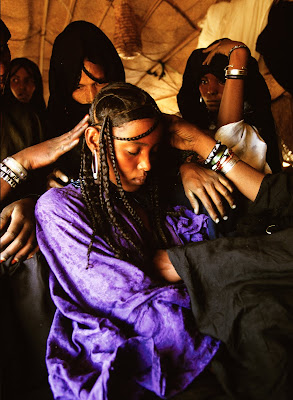


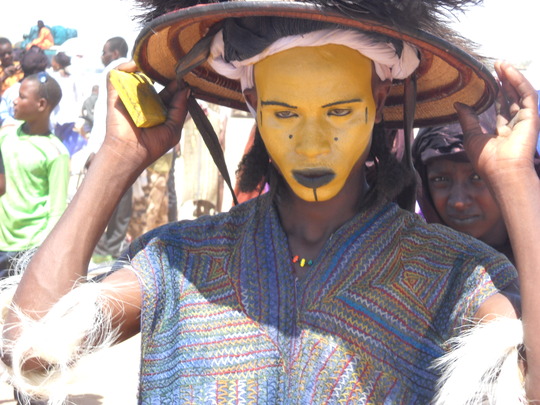


Wodaabe man from Mali at Gerewol Festival beauty Contest for men
The Wodaabe/Mbororo–Fulani, who are the largest nomadic group in the world, play a crucial economic role as seen in the following remark by Weeks (1978: 133), “Their herds of cattle and sheep are the major source of meat for hundreds of villagers, towns and cities from Wadai, beyond the shore of lake Chad to the Atlantic coast of Senegal.”
Mbororo woman from Cameroon
They are known for their beauty (both men and women), elaborate attire and rich cultural ceremonies. Obsessively vain, exotic, strange, and foreign–these are words frequently used by Europeans and Americans
to describe the Wodaabe/Mbororo-Fulani. In her 2001 book, Nomads Who Cultivate Beauty, Mette Bovin confronts these stereotypes. She notes that although many may believe that the tall thin Wodaabe men–who paint their faces yellow, widen their eyes, and quiver their black painted lips during annual dance performances–resemble “homosexuals or transvestites,” Wodaabe men are, in fact, dressing “for the sake of young girls” (p. 41). The Wodaabe, especially men, “use enormous amounts of time, energy and money to become pretty, handsome, beautiful, ’exotic,’ attractive, elegant, refined, and symmetrical in poor surroundings” (p. 9).
Gerewol festival of Wodaabe people
The WoDaaBe/Mbororo-Fulani have a wonderful Gerewol festival, an annual courtship ritual competition. Young men dressed in elaborate ornamentation and made up in traditional face painting gather in lines to dance and sing, vying for the attentions of marriageable young women. In outlining the the yaake dance, Bovin explained that male dancers strive to imitate the grace and elegance associated with the long-legged white cattle egret, attempting to harness the power of the bird. Bovin writes about Wodaabe women that they appear to play a peripheral role.
Yaake dance of Wodaabe peopler
For example, Bovin writes that during yaake performances, women “stand in a crowd at a distance, they look shy, but they are in fact active and important spectators. Women judge and choose among the men!” Bovin continues to state that women “choose not the ”Miss Wodaabe“ but the ”Mr. Wodaabe“ of the year!” (p. 47). In fact, the “names of male beauty contest winners are remembered for several generations” (p. 68).
Wodaabe people from Central African Republic
WoDaaBe/Mbororo-Fulani are used in the world of images through the commercialization of products. Anita Roddick, the founder of the multinational cosmetic company the Body Shop, has associated images of the WoDaaBe/Mbororo-Fulani with her beauty products (see Zinn 1991). Probably, the Body Shop’s association with the WoDaaBe is intended to underline the company’s association with nature, which the company’s identity is based on. In a research trip for the television series Millennium, Roddick spent two weeks with the WoDaaBe/Mbororo-Fulani (Roddick 1991:182). She recounts that: “I have also learned the pure joy that is to be obtained frommixing with simple people whose lives are untainted by what we have laughably described as ‘progress’” (Roddick 1991:181).
WoDaaBe/Mbororo-Fulani have a high degree of mobility, moving on average every three days, making use of the scattered distributed resources and fitting their mode of production into the pulsating environment of their arid habitat (see Johnson 1993: 27; Glantz 1987: 51). Material culture is well adapted to this mobility; belongings few and thus easily transported to a new location. During the rainy season, the different patrilocal lineage groups stay close together making social activities more intense. During the dry season, however, camps are spread out over a large area, making social interaction minimal due to the long distance between the different camps. A council of men (suura) discusses and decides movements within the lineage group, even though each head of the household, always a male, is free to move when and where he wants. This high migratory nature of Wodaabe/Mbororo-Fulani and its attendant destruction of lands and property of the areas (countries) they pass through is one of the major inter-ethnic conflicts in Sub-Saharan Africa.
Wodaabe people from Niger
In the Fula language, woɗa means "taboo", and Woɗaaɓe means "people of the taboo". "Wodaabe" is an Anglicisation of Woɗaaɓe. This is sometimes translated as "those who respect taboos", a reference to the Wodaabe isolation from broader Fulbe culture, and their contention that they retain "older" traditions than their Fulbe neighbors. In contrast, other Fulbe as well as other ethnic groups sometimes refer to the Wodaabe as "Bororo" (singular: Mbororo), a sometimes pejorative name, translated into English as "Cattle Fulani", and meaning "those who dwell in cattle camps". By the 17th century, the Fula people across West Africa were among the first ethnic groups to embrace Islam, were often leaders of those forces which spread Islam, and have been traditionally proud of the urban, literate, and pious life with which this has been related. Both Wodaabe/Mbororo and other Fulbe see in the Wodaabe the echoes of an earlier pastoralist way of life, of which the Wodaabe are proud and of which urban Fulbe are sometimes critical
The Wodaabe/Mbororo-Fulani can be divided into three major ethnic groups identified by the colour of their cattle, style of decoration of their bowls, and migratory movements. These are the ‘Aku-en’, Bodaabe and the ‘Jafun-en’.
Mbororo man from cameroon
WoDaaBe/mboror-Fulani pastoral nomads in Niger live in mobile cattle-camps, their ethnic identity and economic subsistence based on cattle herding. WoDaaBe often refer to themselves as the birds of the bush (solli ladde) or as the people of the bush (taguu ladde), thus associating their ethnic identity strongly with their natural environment, recognizing the economic and symbolic association of humans and environment. In other contexts, however, WoDaaBe characterize themselves as separate from their physical environment, posing the home (wuro) and bush (ladde) as structural oppositions. Cows are described as domesticated and “wild,” indicating their role in mediating between nature and people - between a social and non-socialized space.
In Cameroon Wodaabe/Mbororo’en (singular: Mbororo) are found all over the national territory under four Lamidats (the paramount traditional institution) under whom are found community leaders called Ardos. The four Lamidats are found in Fuigil in the North Province, Lompta in the Adamaoua Province, Sabga in the North West Province and Didango in the West Province.
The Mbororo in Central African Republic can also be found in the prefectures of Ouaka in region 4 in the centre-east; M’bomou in region 6 in the south; Nana-Mambéré in region 3 in the north-west and Ombella-Mpoko in region 1 in the south-west. The 2003 census gave an Mbororo population of 39,299, or 1% of the population. There is a higher proportion of Mbororo in rural areas, where they account for 1.4% of the population, than in urban areas where they represent only 0.2%.
Mbororo woman with her child, Ouham Bac, Central African Republic
Wodaabe/Mbororo-Fulani Migratory nature and area of attachment
WoDaaBe/Mbororo-Fulani have several kinds of migrations, which can be divided into short movements aiming at finding nourishment for animals, and a transhumance movement between rainy season and dry season pasture. In spite of a high degree of mobility, WoDaaBe/Mbororo-Fulani tend to use the same general areas year after year.
Wodaabe woman
WoDaaBe/Mbororo-Fulani have an extensive vocabulary referring to migration movements, and different groups have to some extent different usage (Loftsdóttir 2000). The different movements can be classified according to the length of movement they refer to and the season which migration takes place, in addition to referring to various special distances such as the length from well, the closeness to the previous occupation spot (see also Loftsdóttir 1997).
Mbororo girl
In addition, WoDaaBe identify a historical migration called perol. The term refers to a migration out of the ordinary, often a temporarily exploitation of new and foreign spaces, thus not only taking the group from its area of attachment but to an alien territory. Perol is thus an adaptive strategy used in difficult ecological and political situations. The movement can be permanent, even though probably in most cases people wish to return to their gari.
WoDaaBe/Mbororo-Fulani refer to the dry season pasture or the area around the most frequently used wells as an “area of attachment” by the concepts gari or ngenndi. The concept gari, refers to an area that has either a town or a water-hole place, because “that is the place where people sit down.” Thus, the idea and utilization of gari involves coexistence of human beings with an environment. Even though the rainy season pasture is often in the same area year after year, the rainy season pasture is normally not referred to as gari.
Pastoral societies generally subsist on millet consumption, which provides higher caloric values. In order for a complete dependency on milk to be possible the animal human ratio must be extremely high (Gefu 1992: 20). The association of an “area of attachment” and settlement underlines the importance of millet for pastoral societies, and thus the affiliation with agricultural societies, which constitute a part of WoDaaBe social structure and history (See Dupire 1972: 12). The bush in the context of their area of attachment is thus a highly socialized space, involving the presence and relationship of people of different ethnicities having important trading relationships. In this context, the town10 is also clearly not an opposition to the bush (ladde) in which they live, but a part of it.
It should be underlined that gari does not refer to a populated area. Images awakened when discussing ladde (and thus gari) destruction shows this clearly, phrasing it as ladde wati, translated literally as the “bush has died.” Ladde wati is described as an area that wild animals have left, where trees have been cut down, fields are extensive and population high. As explained to me: “That is no longer a bush.”
WoDaaBe have another concept, ladde hurram, which refers to a more “wild” bush. This concept is used regarding space lacking human settlement, i.e., people, waterholes, and towns are absent. When people explained this concept to me, they emphasized that not only does it refer to a space without human beings but is occupied by thieves and evil spirits ginni (sing. ginnol), making it inherently dangerous. The problem of thieves and spirits also exists in ladde but becomes more acute in ladde hurram, because the presence of people and the intimate knowledge people have of ladde makes the ladde more secure. When these concepts, si'ire (town), ladde (bush), ladde hurram (“wild” bush) are placed in connection with each other, it can be suggested that they existing on a scale moving from a dense human population to the lack of it.
Mbororo man from Mboki, Cameroon
Wodaabe-Mbororo-Fulani Settlement
The WoDaaBe/Mbororo-Fulani home wuro (pl. gure) is composed by several smaller units called cuudi (sing. suudu).The concept wuro goes beyond referring simply to a "house," but describes a sociographic unit, headed by a man, which usually is tied together by kinship (Riesman 1977: 31). The suudu is composed by a bed (leso) and table (saga) which are marked from their surroundings by a half circle of branches placed on the earth. Each suudu belongs to one wife of the household and it is almost exclusively a woman's space. She spends most of her time in or around it, all her belongings are usually there, and she invites her friends and family into this space (see also Sa'ad 1991: 212; Bovin 2001: 62-64). The wuro, however, is seen as belonging to the husband; he takes decisions where to make it, how often and with whom. The mobile characteristics of the wuro means that it is not a structure rooted in a place but characterized by its objects, in addition to referring to highly regulated spaces.
Mbororo woman from south Sudan
These various organization aspects of the wuro, such as who makes it, where, with whom and when, as well as its spatial organizations, are understood not only in gendered terms but also to some extent in ethnic terms. Even though the term wuro is used over the homes of other ethnicities as well, its main organizational characteristics are linked with WoDaaBe/Mbororo-Fulani social and political organizations. The wuro (and the suudu) constitute points of reference in relation to the WoDaaBe/Mbororo-Fulani lineage systems and are often conceptualized as the smallest units of the lineage structure (see also Bonfiglioli 1988). The mobility, crucial to the form and existence of the wuro, is also seen, as previously discussed, as an integrated part of WoDaaBe/Mbororo-Fulani ethnicity.
In a similar fashion to the area of attachment, the wuro is conceptualized as a space of human coexistence, of solidarity and safety. The further away one is from the home or from a human settlement in general, the greater the danger may be waiting in the bush. These dangers are partly derived from the physical characteristics of the bush, where people can get lost and die of thirst but also dangers of being attacked by thieves, ginnol, or in the past, wild animals. WoDaaBe/Mbororo-Fulani survival strategy depends on co-operation and closeness to other human beings, rather than the exclusion of them. The WoDaaBe/Mbororo-Fulani cattle-loans demonstrate that WoDaaBe/Mbororo-Fulani relationships are strategies for a safer survival. Cattle-loans (habana’i) are a social institution among the WoDaaBe/Mbororo-Fulani which redistributes wealth. Individuals can invest in social relationships by lending out their cattle. These strategies of increasing safety in an unpredictable environment are informed and understood with reference to WoDaaBe/Mbororo-Fulani ethnicity, because, as it is explained, "someone who does not want to engage in cattle loans is not a WoDaaBe."
Individuals are also safe as long as they stay within the human settlement, i.e. the home, and the home is safer when not too far from other camps. The camp is, as this man stated, not only a place of safety for human beings but also for the domesticated animals. The cows graze at night in a group (sogal), but smaller animals depend on the safety of the house to avoid being eaten by wild animals. In the dry season when the camps are far from each other, the camps are more vulnerable. The rainy season is the time of prosperity and safety which is to some extent due to the short distance of the houses from each other. In the dry season, the bush is considered to be dangerous (kalledum) because the other camps are far away and crimes occur frequently, partly because people are more vulnerable due to their isolation, but also because of an increased shortage of food. People feared, for example, more for my safety during the dry season in the bush than during the rainy season.
WoDaaBe conceptualize their wuro as a safe area that is, on some level, a part of the bush but also as distinguished by the bush around it. As stated by Riesman, “the bush is at once near and far” (Riesman 1977: 251).
Mbororo Fulani from Cameroon
Language
WoDaaBe/Mbororo-Fulani speak Fula language which belongs to the Senegambian branch of the Niger–Congo language family. It is spoken as a first language by the Fulɓe (Fula or Fulani people) and related groups (such as the Tukulor in the Senegal River Valley) from Senegambia and Guinea to Cameroon and Sudan. It is also spoken as a second language by people in the region.
Wodaabe woman from Chad
History
Instead of focusing on the rich history of the Fulani, Westerners were preoccupied with myths of their pristine origin outside Africa. One theory was that the Fulani were a mixture of Jews and Arabs with a Sudanese tribe of Cushitic origin, who came to Africa in the early days of Islam (see discussion in Meek 1925:95). Lieutenant Boyd Alexander argued that the Fulani are “interesting people of Eastern origin, who are believed to have settled in Egypt from farther East, and to have been driven out of their adopted country during the Theban Dynasty, 2,500 years ago” (Alexander 1908:190). One well known theory regarding the origin of the Fulani was M. Delfosse’s thesis that they were a group of Armaic-speaking Judaeo-Syrians who entered “Negro” Africa from Cyrenaica about 200 A.D. (see discussion in Greenberg 1949:190) and then became the white rulers of Ghana from the fourth to the eighth or ninth century (Meek 1925:95).
Wodaabe nomad girls returning from the well with water hanging in goat skin bags under their donkeys' bellies
To maintain this conception of the caucasoid origin of the Fulani, it was often argued that the language of the Fulani was Hamitic, an idea which was met with wide acceptance (Greenberg 1949:190). Delfosse states that Fulanis were the" fruits of the marriage between Oukba and Bajjo Mango were four children, Deita, Woya, Roroba and Nasi. He claims that, they are the actual ancestors of the Fulani who started speaking Fulfude. Arnott (1970:8), agreeing with the above view, further note that after some time the ancestors separated and one of the group moved to Futa–Toro (Senegal Basin). This was further confirmed by Murdock (1959:415), who linked the Fulani to the Tukular tribe who still inhabit the middle region of Senegal. This view is supported by Sa’ad (1977) in the following statement. “The earliest centre of the Fulani in the western Sudan was the region of Senegal Basin but today, they are found as far as Sudan and Ethiopia…”
In another work by St. Croix (1945: 9), he narrates a legend which explains the origin of the nomadic Fulani. The narration indicates that the nomadic Fulani are descendants of a baby who was left in the bush by the mother due to a quarrel between she and her husband. A spirit found the baby and promised him that, he would roam continuously in the bush but would be rewarded with a lot of wealth. The boy was advised to go to a river where in a line of cattle would emerge. He was counseled by the spirit to lead the line of emerging cattle and not to glance behind. The boy failed to obey the instruction and looked behind. He did so and the emerging cattle from of the river stopped when the most beautiful beast was emerging.
mbororo people
The WoDaaBe have been referred to in more recent publications as primitive fossils having survived through the twentieth century. One text describes them as “unique people, believed to have been among the first inhabitants of Africa, the descendants of the mysterious people of an ancient area who sculptured fantastic drawings into the rocks” (Chesi 1977:65). Another relatively recent text states that nomadic Fulani have a striking similarity to rock paintings in the Tassili caves in Algeria dating from 4000–2000 B.C. (Beckwith
and van Offelen 1983:30).The text claims to be able to separate “negroid figures” in these ancient paintings (Beckwith and van Offelen 1983:30), thus again separating the nomadic Fulani from“blackness.”
Professor John Coleman DeGraft-Johnson, the celebrated African historian from Ghana averred that Fulanis were already in Futa and Senegal when the Jews that fled from Cyrenaica as result of Romans persecution came to meet them. He asserted that "There is perhaps no group of people in Western Sudan with more Jewish blood in them than the pastoral Fulani in Futa. who, by mixing with the people of the shores of Lake Chad, passed on their Jewish blood to the areas around Kanem and Bornu several centuries later."
Wodaabe
Palmer (1967) supports the aforementioned perspective and further recounts that the hybrid and Arabs, who eventually penetrated into the Maghrib in North Africa about 650-750 A.D. mixed with another group of people, the Duradae. According to Palmer, the Duradae are the source of the “Fulani proper”. Meek (1913) on the other hand, links the Fulani with proto-Egyptians and an ancient Libyan tribe. He arrived at this proposition by studying the physique of the Fulani. Furthermore, many writers have traced and attributed the origin of the Fulani to the Arabs as in the case of St. Croix (1945) and Mohammad (1976: 29-33). One of the legends narrated from the latter, explain that the Fulani are descendants of one of the five offspring of Oukba- an Arab, and Bajjo Mango – a Sarakoule. He further narrates that the Fulani were settled in Libya and Egypt and they moved south-westwards to the Bend of Niger and to Futa and Senegal.
The Fulani did not remain or settle permanently along the Senegal River as some of them moved eastward to other parts of Africa, as indicated by Mohammad (1959:226–227). The migration of the nomadic Fulani from Futa–Toro into Ferlo in the south and Kaarto in the east is confirmed by Murdock (1959:417). The Fulani arrived in Masina through Sonika and Bambara in the 14th century, while a vanguard of them infiltrated into Futa Jalon from Senegal. Further migration took them into Hausa land around Sokoto and in Bauchi in Northern Nigeria. Muhammad (1976: 153) explains that the eastward movement was due to the following reasons; the large ocean, which lies to the west; in the north, the Sahara desert is a hindrance and to the south, the thick forest, which breeds the tse-tse fly, made the eastward movement the best option.
Economy
The economy of the Mbororo–Fulani in the early 19th century was exceedingly simple. Cattle had little economic significance and the number a man owned was an index of his wealth and importance. The women were responsible for milking and they carried the milk, with pats of butter floating in it, in large shallow gourds to local markets, where it was exchanged for food grown by cultivators.
Expenditure was on food, salt, payment for ‘gainakos ’(herdsmen) and ‘jangali’ (cattle tax), with occasional purchase of cloth, household goods and saddlery. Mbororo–Fulani sold cattle with the utmost reluctance; the number sold will depend on the expenditures that cannot be met by receipts from the sale of milk and butter by the women. The greater parts of such expenditure were on annual cattle tax paid to the local councils.

Beautiful Mbororo woman
Commercial Trade
The handicraft work of theWoDaaBe can be seen as a commercialization of identity related products because these products are marketed and sold as traditional WoDaaBe items. This manufacturing of identity becomes clearer when one realizes that most of those doing handicraft work today are often engaged in the selling of other identity related products than WoDaaBe jewelry, such as traditional WoDaaBe clothing, Tuareg jewelry, and dance performances, which have been popularized in the general media of the West.
WoDaaBe produce several kinds of jewelry,mostly necklaces and bracelets. There are various models available for sale, and while some people are imaginative and creative in finding new ones others simply copy what has already been done.
For many of the objects cowries are used, which were a currency in West Africa for many centuries. Ibn Batuta, for example, who visited the Mandingo Empire ofMelle, in 1352, mentions that at that time cowries were used as currency (Meek 1925:65). The production of jewelry is divided into a number of steps,many items being made at same time, and is thus similar to an assembly line. The most common items of clothing sold are the woman’s skirt (wudere), young woman’s shirt (henare surbadajo) and a cloth used bymenduring dances.This clothing has extensive work in the same embroidery style, a style that is considered distinctly WoDaaBe. Recently, the styles of the embroidered clothing have been expanded somewhat to adapt to what tourists are more likely to buy.These new items include trousers, blouses, and shirts that are shaped like T-shirts.
Mbororo people
It is relatively common in Niamey that groups of WoDaaBe are hired to show dances, either by development organizations or foreign cultural institutions.Groups of WoDaaBe have gone abroad to show dances,most frequently to France, Belgium or Holland.These dance exhibitions are usually not well paid, but include the possibility of selling “real”WoDaaBe handicrafts or the Tuareg jewelry. Such dance-trips are simultaneously sales trips selling handicrafts and everyday items such as clothing, swords, jewelry,hats,and dance decoration
items. Silver can bring great profits if taken on such trips.
WoDaaBe can be seen in the “tourist streets” of Niamey and even though not as numerous as Tuareg craft makers, they can be no less aggressive in seeking clients. Several co-operatives have been formed in relation to the handicraft work. The non-governmental organization of WoDaaBe jewelry makers called Cooperative Artisana Bororo (WoDaaBe), established in 1994, was probably the first one. The cooperative built a small house for their craft work with the aid of a Belgian development organization, also getting a donation from a white person they had befriended. Such houses make a great difference,making the craft objects more visible and accessible to tourists and are thus greatly desired by most handicraft makers.
Mbororo women
Construction of Gender
Women andmen pass through several life stages. As a newborn, the woman is called Bikkon dewi kesi, a few months later she is Bikkon dewi jakul; as a child surba’el; as a teenager surbaajo; after her first pregnancy and during the first years of motherhood, boofiiDo; as a married woman yarijo; and as an old
woman nayeejo.Women are defined as surbaajo when they are old enough to be part of the nightly gathering of people, generally as a young, childless, unmarried woman. Surbaajo can be a married woman (if her boyfriend does not make her pregnant), but most married women get pregnant soon and thus the role of the surbaajo is more identified with the unmarried women. A surbaajo is sexually available to men (excluding those with whom she would be seen as having an incest taboo). The surbaajo is well aware of her outer appearance, dresses well if she has the means (often her older sisters or parents give her this clothing or her boyfriend, semaru).
Mbororo woman
A woman becomes boofiiDo when she is pregnant with her first child, but her whole period as a boofiiDo lasts for two or three years. If becoming pregnant by one of her boyfriends, a woman’s actual marriage with her intended husband will be swiftly initiated, and her status is transformed into a bofido.The boofiiDo is symbolically an “invisible”woman, dressed in black and without any decoration. She covers her body with a black cloth and head cover but has no shirt. After her child is born, she walks around with her breasts naked, a cloth wrapped around her hips.When becoming a boofiiDo, a woman leaves the homestead of her husband and returns to stay at her parents’ home. During this period, she will not see her husband nor his family and she has in general no interaction with anyone except the members of her own household. Even during the annual gathering of the lineages, she stays secluded. If visitors arrive at her parents’ homestead, she does not make her presence known. She has no relationship with males, neither her husband nor other men. The boofiiDo has a small bed at the house of her mother, which is situated to the left of the table. She is supposed to help at her parents’ house, and is thus considered to be a valuable contribution to the work force.Awoman is only a boofiiDo once in her lifetime.When awoman’s period as a boofiiDo has ended, she becomes yarijo. She can dress again in a colorfulway and interactwith people. Her life has changed, she is a wife and a mother. A yarijo can obviously not have sexual relations with other men, she cannot be part of the night gatherings and she cannot go out late in the evening without her husband’s permission.
A young man coming of age is, however, simply a kajejo, the term used about young unmarried men,married men, and men with a child or children. His role only changes when he is conceptualized as old, or ndottiijo. Kajejo, therefore is someone who goes out and does what he wants, someone who goes out to find dancing
and find women. Briefly stated, according to these men, kajejo is someone who is enjoying life, and he becomes a dotti’owhen he is old and ugly (i.e.,no longer desired by women).
Mbororo kids, Benin
Gender Relations
WoDaaBe society is characterized by strict division of labor, which can be seen as a reflection of the gender segregation in the society as a whole. Women’s sphere of activities is the home, the suudu, in addition to milking related activities, while men’s preoccupation is with the herd. Men and women do not eat together, and a man would never sit down on a straw mat if women were gathered there, just as a woman would not join a group of men.The everyday relationship between men and women is characterized by reserve and avoidance (see discussion in Stenning 1959).Women are a source of pollution for men, particularly in connection with menstruation. The menstruation blood is considered to deprive traditional medicines of their
powers, and thus women are not able to have many medicines for protection, which are an important part of the man’s life and powers.
Mbororo woman, Nigeria
Women are generally treated with respect in an everyday setting but women’s stories of themselves and their lives still directly express their fear of men. They fear especially physical violence from their husbands, who are considered to have the right to discipline them. A woman’s parents are not able to interfere directly in the beating of their daughter, but the father or older brothers of the husband do interfere.
Wodaabe mother and her baby
Marriage
The Wodaabe practice polygamy. Marriages are either arranged by parents when the couple are infants (called “koogal”), or they can be because of love and attraction (called “teegal”). The first step, the puDDol, usually takes place when the girl is very young. It is not important how old the boy iswhen this is done,but the girl has to be under 15 years of age.The puDDol involves the killing of a young bull or a sheep, depending on the wealth of the household.The puDDol is not necessarily done at the annual
Wodaabe bridesmaid
lineage festival.The next ceremony is simply called kobgal,which involves the killing of a bull (2 or 3 years
old) or a big cow, depending on the situation of the household. Usually the girl is around 11 to 14 years old.
The next ceremony is called bosDi kobgal and involves the killing of a sheep, whose meat is eaten by both
families. Finally, there is a series of several gifts.
Koogal marriage: It takes place through the slaughtering of a bull, uniting two families of the same lineage group. The kobgal marriage is arranged by the parents for two young children, and consists of a series of steps which take many years, but always involve either the boy’s family killing an animal or them giving gifts to the girl’s family.
In Wodaabe culture, men openly contest over a woman, and it's up to her to choose who to be with, and the guys are very civil about it too
Teegal marriage: In performing a teegal marriage ceremony (which is marriage between mutual consenting adults), a sheep is usually slaughtered. In some few instances, a bull is slaughtered; this is usually done if the
man is trying to demonstrate a great affection for the woman, and imitates kobgal marriage.
Wodaabe woman and child, Chad
Suka`en: Suka’en is an institution where the father gives his son his first calf. In some cases, if the man has a great many cows or few sons, the daughters receive a suka’en cow from the father. The calf stays with the father’s herd where it grows and will become what later constitutes the son’s herd. It is important to note that the herd of a household does not only belong to the male head of the household but also includes animals belonging to sons who still make their home (wuro)with their father.These animals will form the basis of what the sons can have later in independent households. Animals thus play a central role in social institutions, constituting a medium where relationships are established in WoDaaBe society.
Wodaabe woman
Culture of Wodaabe/Mbororo-Fulani
‘Pulaaku’
The main socio-cultural code for Mbororo–Fulani group is known as pulaaku, a code of behaviour and ethos believed by them to be peculiar to and distinctive of the pastoral Mbororo-Fulani (Kirk-Greene 1986: 42). ‘Pulaaku’ provides both a moral framework and a code of conduct to the pastoral Mbororo- Fulani, and is also maintained by town Fulani. This code of conduct is intimately bound up with nomadic pastoralism and with good animal husbandry. It is also bound up with the fulfilment of duties to elders, wives and the lineage group, and the proper arrangement of marriages. The four dominant strands of ‘pulaaku’ have been identified as: fortitude in adversity and on ability to accept misfortune (munyal); sound common sense and manners (hakkiilo); reserve and modesty in personal relations (semteende); and dignity (neddaaku). For the Mbororo Fulani themselves, ‘pulaaku’ makes them unique and different. It is about dignity and hiding problems.
Pulaaku’ functions as a means of maintaining an ethnic boundary around the Mbororo category, such that it describes an ideology of racial and cultural distinctiveness and superiority that ranks the Mbororo- Fulani above all other ethnic groups (Burnham, 1996:106). The Mbororo Fulani equate their distinctive pastoral way of life with their ethnic origin, to the extent that “there is a strong attachment to the idea of ethnic exclusiveness” (Steening 1959:388) as evidenced by the existence (and use) of disparaging fulfulde terms for sedentary farmers (e.g haabe). There is also a continued tendency to marry within migratory groups, often with close cousins, as a means of preserving ‘pulaaku’. Mbororo culture can therefore be seen as exclusivist in orientation, a factor that has sometimes exacerbated inter-ethnic tension between the Mbororo-Fulani and their farming neighbours. Thus cultural conflict is stereotypically expressed as such:
“The natives in town see the Mbororo Fulani as uneducated, primitive and having a wrong religion. The Mbororo-Fulani in the rural areas looks down on the natives as haabe, mean people who are poor, feel racially superior even to a native who is rich”
As with all cultural codes, pulaaku is not interpreted uniformly amongst in the different ethnic groups, and more broadly remains subject to local interpretation and variations between different Fulani groups across West Africa (Azarya 1999: 6-10).
However, pulaaku provides a unifying factor across the Mbororo-Fulani of Cameroon as between the Jafun’en Bodaabe and Aku’en.
Mbororo woman
Wodaabe Gerewol festival
The Guérewol (var. Guerewol, Gerewol) is an annual courtship ritual competition among the Wodaabe Fula people of Niger. Young men dressed in elaborate ornamentation and made up in traditional face painting gather in lines to dance and sing, vying for the attentions of marriageable young women. The Guérewol occurs each year as the traditionally nomadic Wodaabe cattle herders gather at the southern edge of the Sahara before dispersing south on their dry season pastures.
The most famous gathering point is In-Gall in northwest Niger, where a large festival, market and series of clan meetings take place for both the Wodaabe and the pastoral Tuareg people. The actual dance event is called the Yaake, while other less famous elements—bartering over dowry, competitions or camel races among suitors—make up the week long Guérewol. The Guérewol is found wherever Wodaabe gather: from Niamey, to other places the Wodaabe travel in their transhumance cycle, as far afield as northern Cameroon and Nigeria
Annual gathering
At the end of the rainy season in September, the Wodaabe travel to In-Gall to gather salt and participate at the Cure Salée festival, a meeting of several nomadic groups. Here the young Wodaabe men, with elaborate make-up, feathers and other adornments, perform dances and songs to impress women.
The male beauty ideal of the Wodaabe stresses tallness, white eyes and teeth; the men will often roll their eyes and show their teeth to emphasize these characteristics. The Wodaabe clans will then join for their week-long Guérewol celebration, a contest where the young men's beauty is judged by young women.
Music and dance
The music and line dancing is typical of Fula traditions which have largely disappeared among the vast diaspora of Fula people, many of whom are educated, Muslim, urbanites. This is characterized by group singing, accompanied by clapping, stomping and bells. The Wodaabe Guérewol festival is one of the more famous examples of this style of repeating, hypnotic, and percussive choral traditions, accompanied by a swaying line dancing, where the men interlink arms and rise and fall on their toes.
Wodaabe (Bororo/Fulani) nomad woman pounding millet. Niger. Sahel.
The Guérewol competitions involve the ornamented young men dancing the Yaake in a line, facing a young marriageable woman, sometimes repeatedly over a seven-day period, and for hours on end in the desert sun. Suitors come to the encampment of the woman to prove their interest, stamina, and attractiveness. The participants often drink a fermented bark concoction to enable them to dance for long periods, which reputedly has a hallucinogenic effect
Wodaabe women shielding from the sun
Religion
Although one of the first African tribes to convert to Islam, they preserve many of their Mbororo customs. They follow the Muslim rituals of prayer, fasting and pilgrimages, but because of their fear of the spirit world, they wear fetishes and charms, and practice rituals for protection.
Despite this, they have demonstrated an openness to the Gospel, particularly when they see it worked out in deeds of love and mercy.
Wodaabe people
Tourism
The Guérewol ritual has become a foreign tourist attraction since western films, and magazines such as National Geographic, have prominently featured images of the stylized performance
Wodaabe man
Socio-economic and cultural symbolic role of Cattle
Animals in WoDaaBe/Mbororo-Fulani society have an interconnected symbolic, social and economic meaning. This applied especially to cattle whose multiple roles in WoDaaBe/Mbororo-Fulani society cannot be reduced to a single meaning or purpose. Livestock can be seen as a medium in transforming the shrubs and annual grasses into products that can be used by humans (Johnson 1993: 26). Cows provide people with milk and meat to sell at the market for millet. Not only do cattle carry an reproduction of the social system.
Wodaabe woman from Niger
All major life transitions, such as birth, marriage and death take place with the assistance of cattle. In addition to their role in life transitions, cattle form the basis for the important gift distribution system, habana’i, which both establishes social relationship within and outside the lineage group, leading to the reduction of risk within the pastoral economy. Goats and sheep are a relatively recent addition to WoDaaBe/Mbororo-Fulani economy, serving as a mobile reserve to sell at the market, in addition to sheep serving ceremonial purposes as in other Islamic communities. Donkeys have largely replaced the package-ox in transporting people and belongings and camels, which are used to scout the area and for transportation purposes.
Mbororo shepherdess
The WoDaaBe distinguish the Bororo Zebu breed of cows from other breeds of cattle, identifying it as a “true” cow (na’i gonga). When discussing livestock, people often use the unmarked category “cows” to refer to the Bororo Zebu but specify when referring to other breeds of cattle. The conceptualizations of cattle seem to have some relevance to ethnicity, because other breeds of cattle are seen as belonging to other ethnicities, while the Bororo cow is a WoDaaBe cow (there are of course still many WoDaaBe who have Azawak cows).
The Bororo cow is characterized by a special attachment to its owner, being extremely obeying and responding well to commands given by people, in addition to knowing their names. They get used to specific people handling them, refusing cooperating with strangers, such as in terms of milking and watering. WoDaaBe sees this attachment to the owner as serving practical purposes because, as they frequently emphasize, it is almost impossible to steal a Bororo cow. They run away from a stranger, refusing cooperation. The Bororo cows are also characterized as fiercely independent and can in some situations be dangerous to people. Dupire points out that they can merely be seen as partly domesticated animals, referring to their characteristic as "semi-sauvage" (Dupire 1962: 95). WoDaaBe describe Bororo cattle as having djikku (character), which is the same term as used in relation to people. To have djikku is usually characterized negatively by WoDaaBe in relation to people, then as referring to loss of self-control, but the use of such a term in relation to cows can be seen as placing them on the same level as people, conceptualizing them as animals with temper and independent personalities. The Azawak breed of cows, on the other hand, is seen as lacking character and not forming ties with people. The Azawak cows are docile animals, making them more suitable as pack-oxen in the past, even though some Bororo cows also took this role. Cattle have individual names. Each animal carries the same name as the animal that gave birth to it, which is curious considering that the WoDaaBe are a patrilineal society. This naming tradition is interesting because it appears almost as if the same cow is being born again and again, thus creating continuity with the past. People know that an animal with the same name also belonged to their forefathers. Other kinds of animals occasionally have names, but not as uniformly as cattle. The names of specific cattle are not only used within the family but are often well known outside the family, even among members of distant families.
The various taboos associated with objects having to do with cattle show the importance of cows, both in terms of subsistence and symbolism. The calf rope (dangul) has several taboos, one of its most important being that it should not be stepped on or over. The milking bowl (birdude) also has various taboos associated with it and should not be used for any other activity than milking, but calabashes used to eat from generally do not have taboos associated with them. A woman with unbraided hair cannot enter the dudal (the cattle area of the camp) and no one can take charcoal from this fire.The breaking of these taboos will usually cause misfortune to the herd, a calf dying or a cow getting lost or ill. Dupire points out that the concepts yiite
(fire), nagge (cow) and naange (sun) all belong to the same class (nge) in the Fulfulde language, being the only concepts constituting that class.
Unlike the Western intellectual tradition, which has tended to pose emotional and rational aspects as binary oppositions, WoDaBe see these as coexisting. When people discuss their affection for cows vis-à-vis other animals, the pragmatic element of nourishment is often placed as a central component of affection. WoDaaBe say that they never stop breast-feeding (muusini) because they continue feeding from their cows’ milk. The dependency on milk becomes so intense that during the droughts of 1968-1974 and 1984, many young WoDaaBe attributed the death of elderly people to the fact that they did not get any milk to drink for the first time in their lives.
Wodaabe kids
The WoDaaBe do not consume milk of camels nor would they eat its meat. This is due to, according to themselves, their adherence to Islam. As some Wodaabe/Mboror-Fulani say “I don't really care about camels, because the camel will not feed me,” (see also Loftsdóttir 1997). WoDaaBe underline that the well-being of the cows is the pre-condition of the well-being of human beings (Dupire 1962: 53). “WoDaaBe put their strength to the cow, because WoDaaBe have to take care of their cows, just as the cows take care of WoDaaBe.” Its as a result of this personal and intimate relationship that why cows are given names while most other animals are not given names. People did not seem to view their relationship with cows as one of dominance and use, but more in terms of equality and reciprocity. "My people are as masube (slaves) of cows, all you do is for your cows. If it is the dry season, you want to go and get water for your cows. Your cows only wait, observing you working. You have to do all the work, you have to think about how to get the water (Akali; from notebook 10.3.1998).
The term sibiiru is also a powerful source of information regarding the ties between WoDaaBe, land and cattle. It literally refers to the navel and the umbilical cord, but also to one's place of origin as a part of a social group. At the birth of a WoDaaBe child, the cord is cut and then buried close to the wood sticks (kopeeje) that hold the calf rope in place. It is quite interesting that the cord should be buried close to the calf rope, where the calves are tied during milking.
Mbororo people from CAR
The symbolic meaning of the association of land with birth and the act of digging the cord next to the calf-rope is extensive. The calf-rope's extensive taboos, which if broken lead to the herd's misfortune, indicate the strong bonds placed between the calf-rope and cattle. As previously discussed, cattle are characterized by WoDaaBe as semi-wild, but given rather human characteristics unlike other animals (such as names and personality). It seems thus to be highly symbolic and meaningful that the cord is placed in the earth next to an item (the calf-rope) symbolizing the herd. It ties people, land and cattle in a close unity. It could also be significant that the concept sibiiru is used both over the umbilical cord and the navel, stressing the sibiiru as not only a cord which can be cut away, as the English term implies, but continues to be a part of a person.
Furthermore, whereas the nourishing cord places an association between birth and the land, cattle can in a sense been seen as re-materializing in the cord, being essential for subsistence as the cord itself, being the medium that allows people to subsist within this environment, transforming grasses into products that can be consumed by humans. The cattle and the cord both constitute nourishing ties between humans and their surroundings. The term sibiiru can thus been seen as referring to a symbolic association of the womb and the land where one originated, united in a nourishing cord, the cattle.
WoDaaBe thus see their relationship with cattle as one of protection and reciprocity. As stated by Riesman in his ethnography on the Jelgobe Fulani, cattle can be seen as mediators of bush and human settlement (Riesman 1977: 255). Cattle are crucial economic and symbolic components of their society, making the production in the Sahel environment possible as well as being integrated into the reproduction of their social system. Cattle take some of the similar characteristics as people, having character and personal names, but are at the same time still conceptualized as less domesticated than other animals.
Mbororo woman
Ginnol and the Social Space
The ginnol is interesting in the context of the conceptualization of human - environment relations because it indicates a further conceptualization of the bush as a non-socialized space. The ginnol is probably known to most Fulani groups, the concept has been translated as "devil" or "spirit." (CRDTO 1971). In the dictionary by Osborn et al., the concepts ginnaary, jinni, or ginnawol are seen as referring to spirits (Osborn et al 1993). Ginnol is characterized as a creature of the bush, fearing the WoDaaBe home (wuro) and generally not coming close to it, only making its appearance known in the bush. The most frequent encounters of ginnol are the sights of its fire from a distance, which appears as a distant camp. Usually this happens to someone traveling alone at night perhaps with his herd. The fire disappears and then reappears in a different place, only to disappear once again. Sometimes voices accompany this vision as people gather around the fire. Even though in most cases ginnol only exposes itself in the dark, it also happens to make appearances in daylight, thus indicating the ladde (even though within the area of attachment) as a dangerous place for someone alone. The ginnol hesitates to enter the wuro, which is an assembly of objects and relationships, even though not tied down to a specific place in the area.
Ginnol sometimes kills people but more frequently is said to render people mad or to disfigure them in one way or another. Human beings are not able to see the ginnol, but only what is called busaka or a mbelu, which is the reflection or a shadow of the ginnol. The ginnol is also a shape-shifter and can take the appearance of both humans and animals. It usually attacks only a single individual and is thus considered dangerous to someone travelling alone, even though there are cases it making itself known to two or three people. As pointed out by Riesman in relation to the Jelgobe Fulani, the ginnol attacks people who are in state of vulnerability (Riesman 1997: 220). My interest in the ginnol in this context is how it reflects an interesting dichotomy between the wuro and the bush. The wuro is a moveable space of order and safety while its surrounding areas can be dangerous and unpredictable. The fact that the ginnol generally attacks someone alone re-emphasizes the importance of social networking and solidarity. In contexts of narratives of the ginnol, a binary opposition can almost be drawn between the wuro and the ladde; the former characterized by solidarity but the latter by isolation; the former safety and regulations but the latter danger and chaos.
Mbororo boy
Cattle and Ginnol
Further information about WoDaaBe’s conceptualization of their relationship with the bush is observed in the relationship of ginnol and animals. I previously suggested that the WoDaaBe do not conceptualize their relationship with their cows as being hierarchical as much as a symbiotic reciprocity, where humans take care of their cows and vice versa. WoDaaBe origin myths emphasize that cows came to live with humans by their own will, and they are seen as always maintaining their independent character. The wuro involves the coexistence of humans and animals, and that the cows mediate between the bush and the home.
Cows see the ginnol, which is attached to the herd and often stays close to it. At night, some people are afraid to enter their cattle herd because the ginnol may be there. The ginnol will not enter the cattle area if the cattle coral fire (duDal) is burning, because it fears fire, but waits until it eventually dies out. The relationship of cows and ginnol is also expressed in some cows being considered to have ginnol. These are cows that do not have an uniform rope, but a mixture of many colors, especially if the animal is an ox (budjeri) or bull (kalhaldi). WoDaaBe see mixture of different elements as inherently bad, expressed in that the mixing of different food being dangerous for people’s health, and a person of mixed ancestry is considered to be more dangerous than one who is of "pure" ancestry. Cattle with ginnol are thus especially dangerous to people.
Another association between ginnol, cows and people has to do with the moral conduct of WoDaaBe, which requires the person to share his or her resources with other WoDaaBe. It should be noted, however, that the following information depends on very few sources and I have also heard the same story without the association with the ginnol. According to these informants, a person who has a great deal of cows, and is not generous in giving or loaning them in habana'i may suffer great misfortune from the hand of the ginnol. When that happens, a strange sound is suddenly heard from the herd, like someone is beating a drum or a calabash (tumBal). The herd becomes restless, but the beating continues and there is no one to be seen.
Mbororo woman from Sudan
If the person who owns the cows does not start immediately to kill his own cows, he will surely die. In order to save his life, he should call people and ask them to help him. He should start killing his animals, by slashing their foot by the sword in order to be able to kill them more easily. Many cows have to be killed (between ten or twenty according to one informant) and afterwards the meat is cooked and distributed. I was told that this was "work ginnol" because someone's cows are too numerous and he is not willing to share them with others. What is of special interest here is that the ginnol seems to serve as a moral reminder of one fellow WoDaaBe against another, using the herd as a mediator.
Mbororo woman with tattoo from Cameroon
source:"Birds of the Bush: Wodaabe Distinctions of Society and Nature" by KRISTÍN LOFTSDÓTTIR, University of Iceland
Mbororo woam
Wodaabe from Chad
Wodaabe Girl carrying water. Baguirmienne (Baguirmi), Chad. ca. 1950 | Scanned postcard image
Wodaabe
Mbororo man and woman move their cattle. The Mbororo tribe are nomadic herders related to the Fulani tribes of West Africa. They are not accepted in southern Sudan so they are moving north through the country, unsure if they will be accepted there.
COPYRIGHT:Panos Pictures /Felix Features
The Girls at the Agadez Learning Center
Mbororo womwn from Sudan
Mbororo people at the Gerewol
Mbororo from DRC
Wodaabe, Chad
Mbororo girl,Nigeria
Mbororo kids dancing, Central African Republic
Wodaabe

Wodaabe women of Niger


